Category Archives: Locations

Gordon Batty Collection – Parish Church of St. Chad, Rochdale.
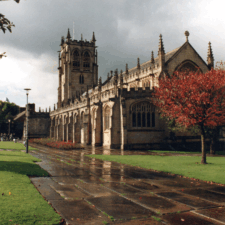
St. Chad's Parish Church, Rochdale

There is a tradition that the Parish Church of Rochdale was intended to have been erected down by the river, but that when the foundations were being laid, overnight they mysteriously disappeared, to re-appear at the top of the hill near the present site of the church. Several attempts were made to build in the valley, but each time the same thing occurred, and the materials would mysteriously be moved over-night, so eventually it was agreed to build the church on its present site, and no further trouble was experienced. This in not an unfamiliar tale and St. Chad’s is not the only church to which it has been ascribed.

The church was built and consecrated in 1170 and restored and enlarged in 1857 and 1885

Up to 1635 the floor of the church was hard packed earth, kept warm in winter by the rushes that were strewn on the floor. These rushes were gathered ceremoniously in August every year and borne on a cart in procession, accompanied by musicians, morris dancers, and the congregation to the Parish Church where they were laid on the floor with ceremony. On occasions, hedgehogs were released among the rushes in an effort to keep down the pests and vermin. Sometime after 1635 the church floor was paved with stone, but nevertheless, the Rushbearing Ceremony continued into the twentieth century when it lapsed for some years before being revived in August 1986.

In 1552, a two manual organ was installed in the church, one of only four such organs found in churches at that time in the country; the others being in Manchester, Ormskirk and Middleton.

A west gallery was erected in 1693, to be followed in 1669 by the erection of the south gallery, but both of these were removed during a period of alterations in 1885.

The belfrey in 1719 contained five bells, which were increased to six in June 1751, and another bell was added in 1787 taking the number to eight. In 1812 a new tenor bell was struck.

The church bells played an important part in teh life of the people of Rochdale for many centuries, ringing out the curfew at eight O’clock every evening. The curfew bell was rung in every parish church by the Royal Command of William I – The Conquerer – the reason being that in his day, and for many centuries after, buildings consisted of wood and thatched roofs, and as such were dangerously liable to catch fire, so the king ordered that all churches should ring the curfew bell an hour before sunset to warn the population that it was time to damp down their fires for the night. Originally the bell was called the ‘covre feu’ (Cover fire) but with time became corrupted to curfew. In time it became less essential to ring out this warning but it had become such a tradition that it was continued throughout the centuries.

For many years a bell was rung at 5:45am on workdays to remind working people of the need to rise and prepare for the day’s labour, so that no-one could make the excuse that they were unaware of the time because they could not afford a watch or clock.

For many years a public clock existed in the church tower, this can be seen in the many old prints that still exist of it, and in 1788, a local man, John Barnish, was commissionesd to make a new clock to replace the one that had worn out, for which service he was paid the sum of £350. This clock chimed a tune on the hour, playing a different tune for each day of the week. These tunes were, starting with Sunday:-

  • he Old 104th Psalm Tune
  • Lovely Nancy
  • Life Let Us Cherish
  • Ipswich
  • Port Patrick
  • The Old 103rd Psalm Tune
  • Britons Strike Home

In 1872 the clock dials were removed and used to face the clock mounted in Dearnley Workhouse – which later became Birch Hill Hospital – where they can still be seen at the present time.

The Rectory

Rochdale Rectory

The present building was erected in 1752, the Vicar at the time was Dr. Dunster, and was designed on the lines of a Georgean house in Red Lion Square in London, prior to this time the Rectory was an ancient thatched building.

In the Rectory garden there is reputed to be a section of Anglo-Saxon stone wall which is thought to be the remains of an earlier church, built by one of St. Augustine’s missionaries, and which stood on the site before the present church.

In the early nineteenth century the living of the Rochdale Church was one of the richest in the country, much of the wealth coming from the nearby Glebe Lands which in 1783 covered one hundred and thirty acres, and which included Broadfield Park.
The Eleanor Crosses

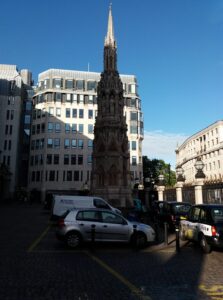
Replica cross outside Charing Cross Station

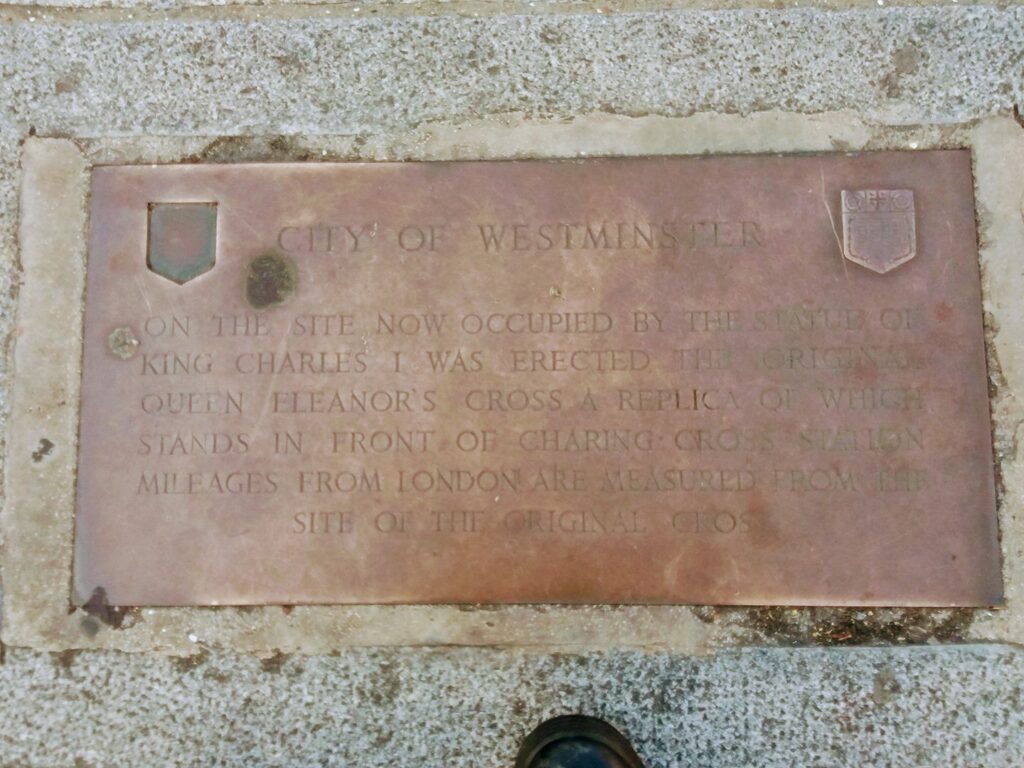
When you see road signs telling you the distance to London the distance given is to a point at the South of Trafalgar Square where a statue to Charles I currently stands. A plaque on the floor tells you that this was the location of the original Charing Cross (a replica of which now stands outside Charing Cross Station.

To find out how the original hamlet of Charing came to get such a monument and the addition to it’s name, we have to go back to the end of the 13th Century.

Site of the original Cross in Trafalgar Square

England at that time was ruled by Edward I (Edward Longshanks, the Hammer of the Scots) who at the age of 14 had been married to Eleanor of Castile as a way of averting an invasion of the English province of Gascony.

Despite being an arranged marriage, the relationship was close and Eleanor travelled extensively with her husband even joining him at Acre during the 8th Crusade.

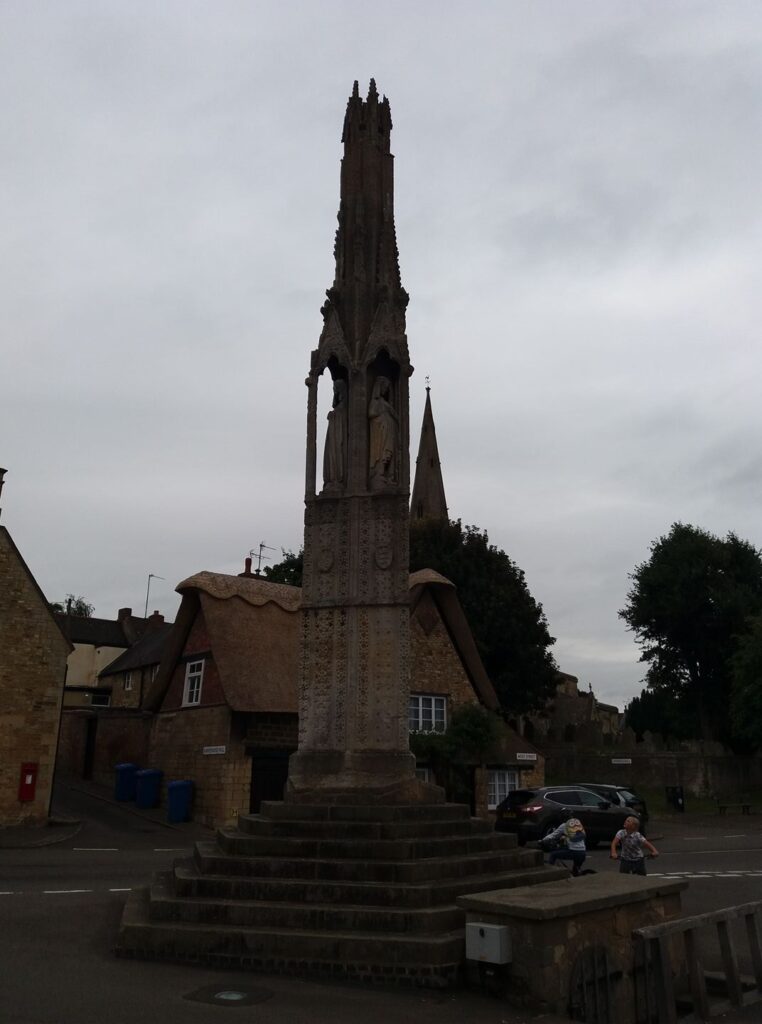
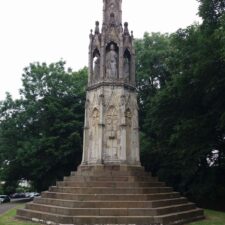
Eleanor Cross in Geddington

In 1290, the King and his wife made a tour of Eleanor’s lands in the North of England. During the tour, Eleanor’s health started to decline and slow their journey. Edward was forced to summon his lords to Clipstone in Nottinghamshire for his Autumn parliament. Once matters of state were completed, the journey resumed but her health meant they were travelling less than 8 miles a day.

Just 7 miles from their destination of Lincoln, the journey was abandoned at the villiage of Harby. The ailing Queen was lodged in the house of Richard de Weston where she died on the evening of 28th November, her husband at her side.

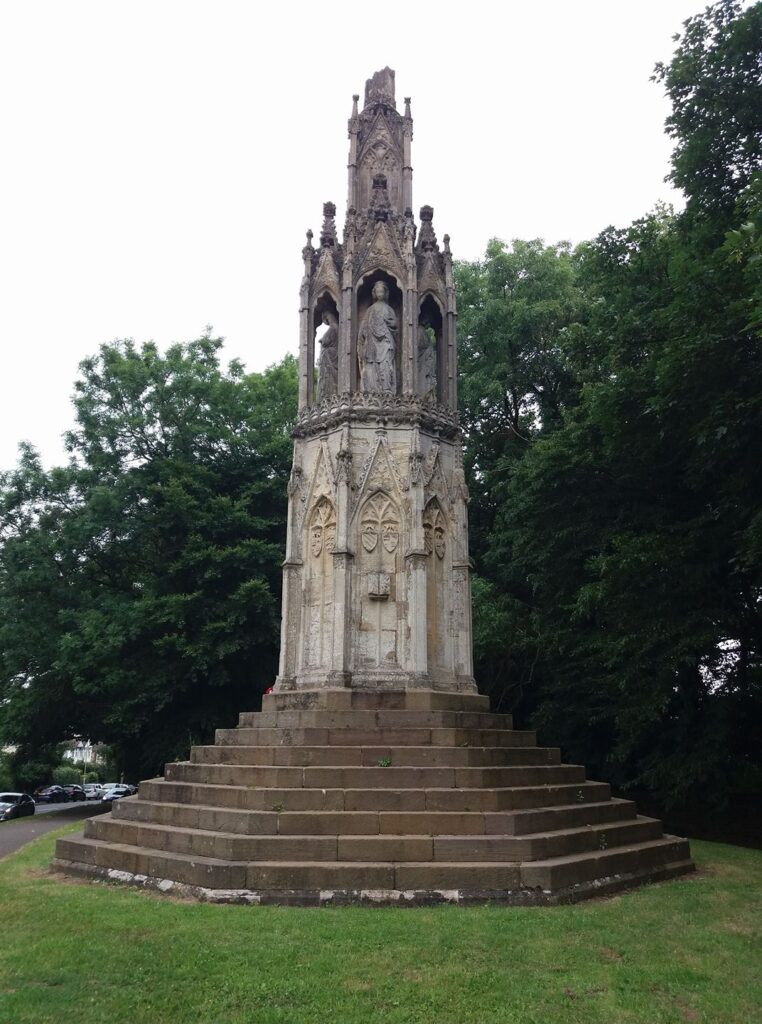
Eleanor Cross in Hardingstone

After being embalmed at Lincoln (her viscera removed at the embalming are buried in Lincoln Cathedral), her body was taken in state back to Westminster Abbey for her funeral which took place on the 17th December. Her heart was buried separately at the Dominican priory at Blackfriars along side that of her son Alphonso who had died 6 years earlier.

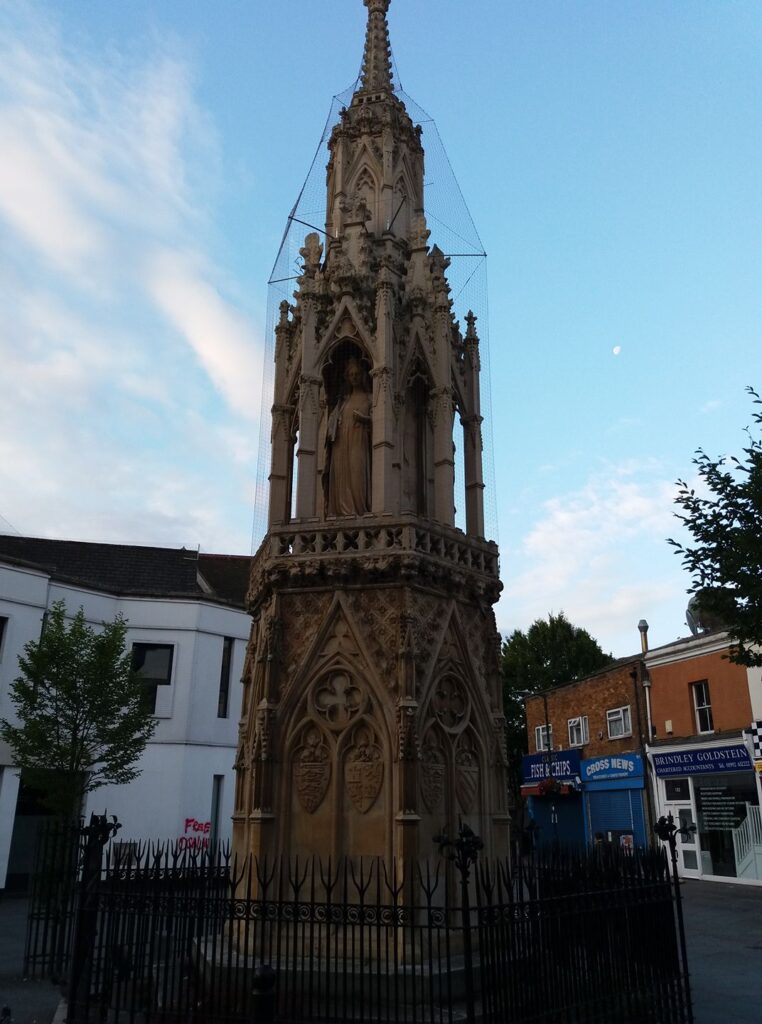
Eleanor Cross at Waltham Cross

The King ordered memorial crosses of immense hight to be erected at the places where the funeral procession from Lincoln had stopped each night. (Lincoln, Grantham, Stamford, Geddington*, Hardingstone* near Northampton, Stony Stratford, Woburn, Dunstable, St. Albans, Waltham Cross*, Westcheap and Charing Cross) He also ordered that two wax candles were to burn for all time beside her tomb in Westminster Abbey.

The candles burned for two and a half centuries until the Reformation brought the practice to an end.

Three of the crosses have survived at Geddington, Hardingstone and Waltham Cross, although they have been restored over the years. Some were lost to neglect, others destroyed in a purge of Monuments of Idolatry and Superstition during the Civil War.

At Charing Cross, it’s original site usurped by the statue of Charles I, an embellished replica was erected in 1865 outside the newly built Charing Cross railway station.

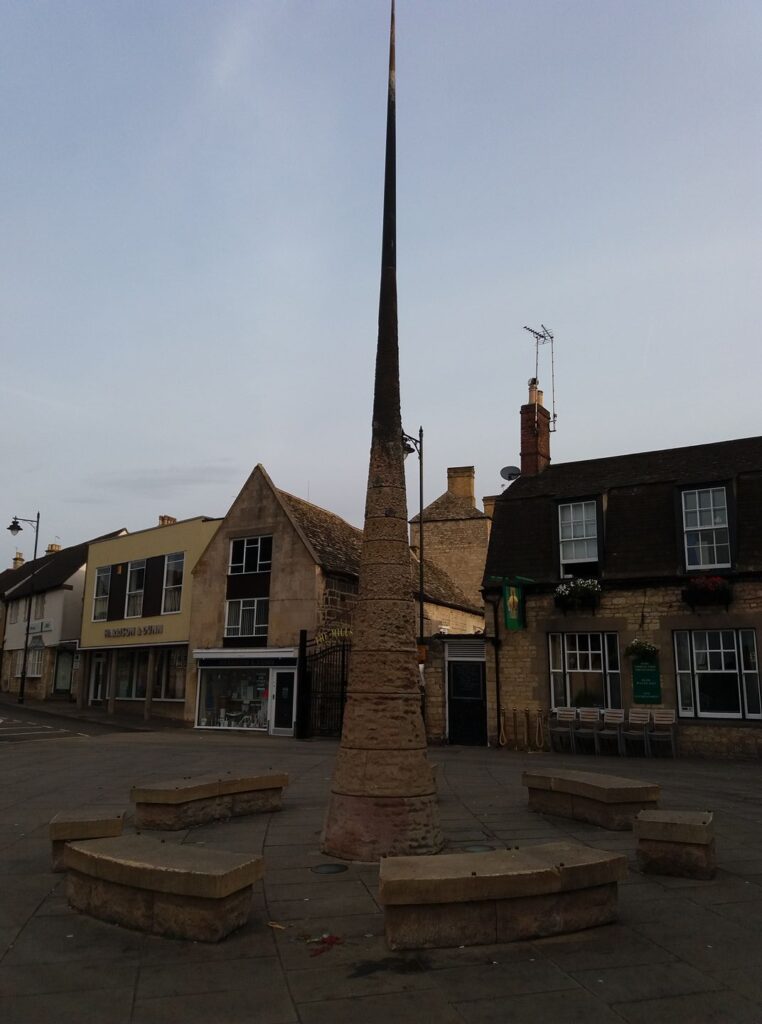
In 2007 a modern memorial was built in Stamford to commemorate the original cross, the tall slender spire is carved with roses a reference to the small piece of the original cross that still remains.

The modern memorial at Stamford

Rochdale Town Hall Fire

Rochdale Town Hall, is a fine example of gothic revival architecture and home to some of the best modern stained glass in the world. The grandeur of this building was such that according to local legend, Hitler had plans to take the building stone by stone back to Germany if he won the war. This is also supposedly the reason why Rochdale, despite it’s industry, escaped pretty much unscathed during the German bombings.

A competition was held to produce a design for the building which was won by William Henry Crossland. Work started in 1866 on the site of an abandoned 17th Century mansion and was completed five years later at a cost of £160,000 (eight times the original budget, and a remarkable sum for a town the size of Rochdale.) the work was so costly that to this day some of the internal decoration remains unfinished.

But what visitors to the town may not know is that the building you see today is different from the original.

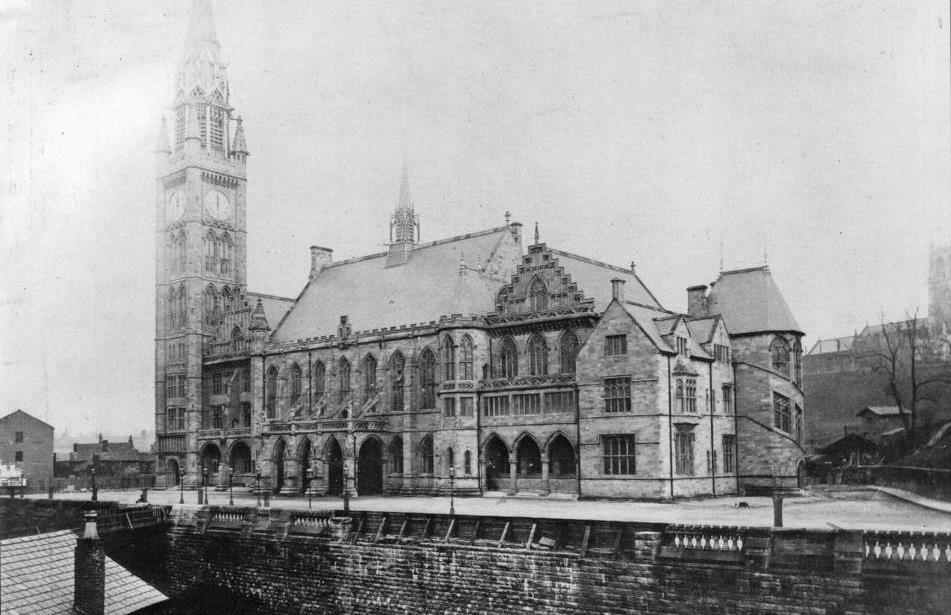
The original clock tower was 134 feet high and had a 106 foot wooden spire richly gilded and surmounted by figures of Saint George and the Dragon.

Rochdale Town Hall prior to the fire of 1883

But in 1882, dry rot was discovered in the spire and after much deliberation contractors were engaged to dismantle and rebuild it.

Whether by accident or by an attempt to speed up the process at 9:20pm on 10th April 1883 a fire was discovered in the Clock Tower. Chief Constable, Wilkinson sent a telegram to the fire-brigades in Oldham, Heywood and Milnrow to provide assistance.

Although the Rochdale fire-brigade was based in the town hall (now the registry office) Oldham and Milnrow were first to start tackling the blaze.

Oldham fire-brigade having arrived in 25 minutes were ready for action, but the Rochdale engine was forced to gallop round the town hall in order to draw enough air to get steam up to power their pumps.

Meanwhile thousands of people gathered around the edges of the town hall square to observe the horrifying spectacle.

The gilding of the spire reflected the blood-red glow of the flames and the clock faces shone far brighter than the gas lamps that usually illuminated them. Occasionally could be heard a shout, or a scream of terror from some female, as fragments of burning material came to earth with a great thud.

As the fire wrapped the tower in a deadly embrace streams of molten lead ran down from the spire and by half past ten the wood of the spire was consumed and the iron framework, having been heated to almost white-hot, gave way crashing to the ground at the rear of the town hall.

With the town-clerk’s offices in imminent danger of destruction, the clerk, with Thomas Foy and another man. ran inside to rescue as many documents as they could. At the same time Alderman Taylor called upon one or two men to follow him, which they did unhesitatingly, and went up to the Free Library  and began removing the paintings and books.

As the spire crashed down a great rod from the spire made a large hole in the roof of the clerk’s office and large lumps of bell metal fell into the room. A similar scene unfolded in the library with large lumps of metal and debris raining down.

Luckily none of the men were killed, but Police-constables Shaw and Schofield  were badly burned by moulten lead, however despite this they were able to continue their duties.

It took until one o’clock for the fire to be brought under control.

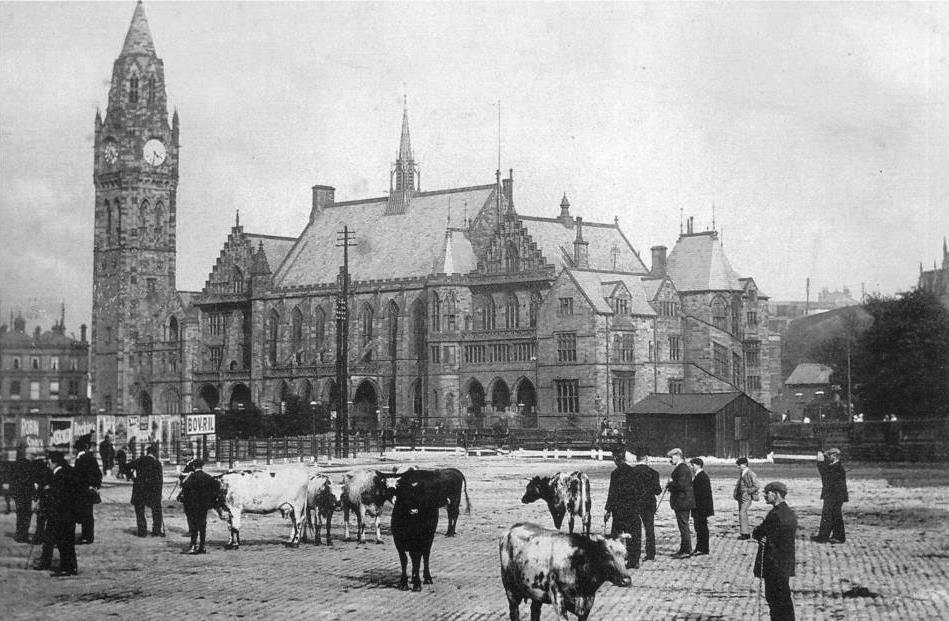
Rochdale Town Hall around 1908 showing the replacement clock-tower

The following morning when the Heywood fire-brigade arrived, (Having only just received the message as the local telegraph office closed at 8pm), only one or two slightly smoldering beams remained.

The replacement clock tower and stone spire was designed by Alfred Waterhouse two years later and opened in 1888. It stands 15 yards from the site of the original tower.

The rooms at the base of the original clock tower were preserved and still form part of the main body of the town hall.

Stott Hall Farm – A Modern Myth

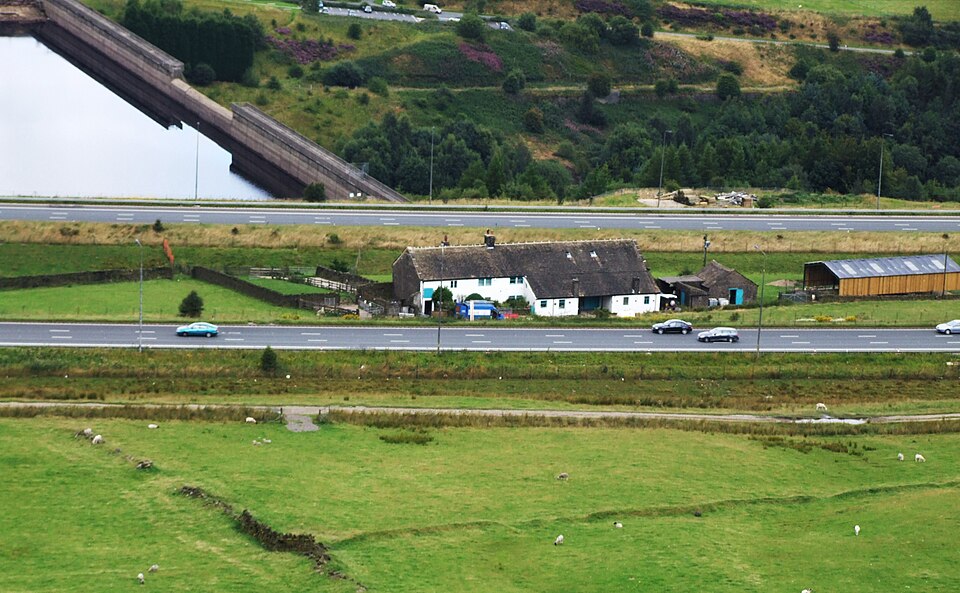
Stott Hall Farm

In the 1970′s, the M62 (built to connect Hull and Liverpool) forged it’s way across the rugged Pennine hills making it the highest motorway in England. Just over the border into Yorkshire lies Stott Hall Farm, instantly recognisable to anyone who has traveled this route and quite a few who haven’t.

The farmhouse (built in 1737) now stands isolated by the two carriageways of this busy motorway, which pass to either side. Modern mythology would have us believe that this was all down to the stubbornness of Ken Wild, the man who lived in the farm at the time.

Whilst hundreds of homes were demolished to make way for this major artery across the country, Stott Hall Farm remained standing. Despite offers of ludicrously large sums of money by bowler-hatted civil servants who reluctantly came up from Whitehall to this desolate location, the farmer refused to budge and the Government was forced instead to change the plans at great expense.

The truth is, that it was the land itself that forced the mile long rent, the waterlogged moorland and steep incline on the hill making it impossible (at the time at least) to construct the two carriageways side by side without the land slipping and destroying the construction.