Author Archives: Iain Monks

The Rainhill Trials

Locomotive competition at Rainhill

In 1824 the Liverpool and Manchester Railway Company was set up by merchants in the area in order to facilitate transport between the two major cities. The idea was heavily influenced by William James a land surveyor and property investor who had the vision of a national railway network after seeing the development of independent colliery lines and the advancement of locomotive technology.

Up until this point railways were generally run using a mixture of cables powered by stationary steam engines and horse haulage, occasionally using steam locomotives for short sections. George Stephenson, engineer for the project advocated using locomotives for the entire line to overcome the issue with cable haulage that one technical issue could paralise the entire system.

In 1829 as the construction of the line neared completion the directors of the company were still unsure how to power the railway, and so it was decided to hold a competition with a prize of £500, to find a locomotive that could prove the viability of the idea.

Each locomotive was required to haul a load of three times its own weight at a speed of at least 10mph. The trial would take place on the track at Rainhill and each locomotive would be required to travel up the track and return ten times which would come to 35 miles (roughly the distance between Liverpool and Manchester). Due to concern that the rails would break the locomotive would also have to weigh less than six tons including its compliment of water (a machine of lighter weight being preferred in the case of a draw). The price of the engine was to be less than £550.

The competition was due to start on the 1st of October 1829, but this was extended in order to give the entrants time to make their machines ready after their journey by ship and waggon to Rainhill. On 6th October 1829 the Rainhill Trials began. Of the ten entrants to the competition only four made it to the trials, Novelty, Perseverence, Rocket and Sans Pareil.
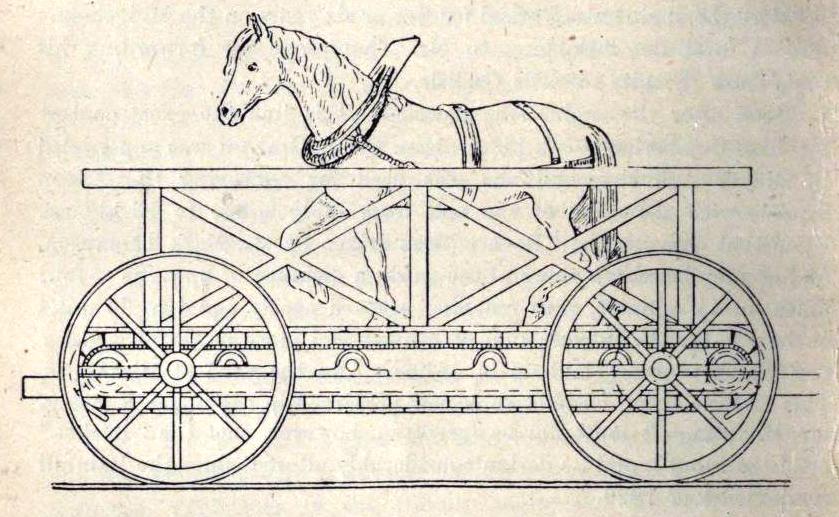
Another entrant Cycloped was disqualified as instead of steam the locomotive was powered by a horse on a treadmill, it could not reach the required speed and was further hampered when the horse broke through the floor of the vehicle.

Perseverance was damaged in transit to the trials and it would take until the final day of the contest to get her running.

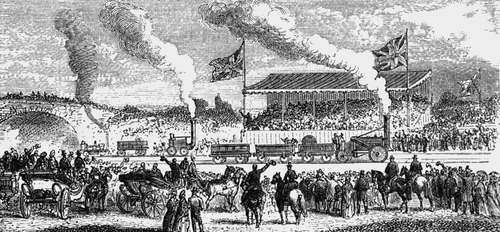
People came from far and wide to see the trials, many thousands of people lined the route and stands were erected for the viewing public.

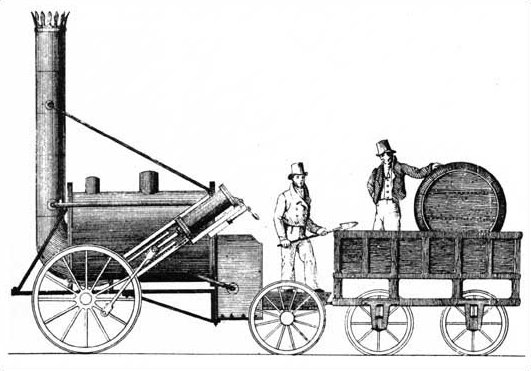
Rocket though not the first listed for the test was the first locomotive ready and was paraded up and down the track for 12 miles without interruption in around 53 minutes.

Novelty was next called out it was a compact engine weighing just over three tons and was peculiar for the bellows that forced air through the firebox. The exhibited engine at times reached twenty-four miles per hour.

Stephenson's Rocket

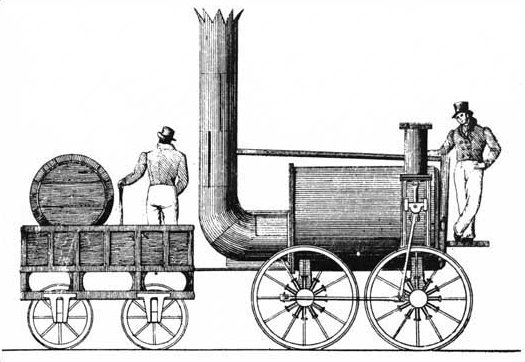
Mr. Timothy Hackworth’s Sans Pareil was the last to be exhibited that day, the engine was similar to the locomotive  George Stephenson had constructed for the Stockton and Darlington Railway where Mr. Hackworth worked as a foreman.

The following day both Novelty and Sans Pareil suffered mechanical failures and the contest was postponed until the following day. To entertain the disappointed crowds Rocket was hitched to a coach containing 30 people and ran along the route attaining speeds of twenty to thirty miles per hour.

At 8am on the 8th October Rocket was brought out in order to take the test under the prescribed conditions. The fire-box was ignited and the required pressure was reached within an hour. The engine then started its journey and pulling 13 tons in waggons completed the required distance. The maximum speed was measured at twenty-nine miles per hour, almost three times the required speed, and the average over the whole of the journeys was fifteen miles per hour.
It wasn’t until the 10th that Novelty was fit for the trial. Only around seven tons was coupled up to the locomotive and the vehicle passed the first post in good style but on the return journey the pipe from the forcing-pump burst and brought an end to the trial.

It was the 13th before Sans Pareil was able to run, but on being filled with water it was found to be over the allowed weight. The judges, however, allowed the engine to run so they could consider whether it had any merits which would entitle it to favourable consideration. It started well, achieving an average speed of fourteen miles per hour, but on the eighth trip the cold-water pump failed, and the locomotive was unable to continue.

By this time Perseverance had finally been revived from the damage sustained on the way to Rainhill and it was decided that the following day would see the conclusion of the trials.

The owners of Novelty petitioned for another chance at the trial, but once again the locomotive broke down and it was eliminated from the competition. A request was also made for another chance for Sans Pareil, but this was refused due to the weight issue and also because the design of the blastpipe expelled large amounts of coke out of the chimney unburnt leading to it requiring about 692 lbs per hour to run.

Perseverence was found to be unable to reach more than six miles an hour and so was withdrawn before the required distance was covered leaving Rocket as the only Locomotive to complete the trial and the victor.
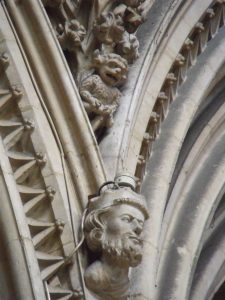
The Lincoln Imp

In medieval times it is claimed that the Devil sent a plague of imps to the northern part of the country to cause mischief.

Those imps came first to St. Mary’s church in Chesterfield and amused themselves by twisting the spire.

The imps spread out around the area causing diverse mishaps and irritations.

It was not long before two of them arrived at Lincoln Cathedral, at that time the tallest building in the world.

The imps set about wreaking havock, smashing stained glass windows, knocking the bishop to the floor, blowing out all the candles and upsetting the tables and chairs.

Summoned by the infernal noise, an angel appeared from a bible that had been left open and chastised the imps. One hid in the detritus caused by their vandalism, but the other enboldened imp started throwing stones at its adversary from it’s perch high up in the Angel Choir.

Finally weary of the onslaught, “Wicked Imp, be turned to stone!” proclaimed the angel.

The wizened creature can be seen in his final position to this day.

Of the imp who hid, it is said he escaped and continued to cause mischief around the country until he was finally cornered by the angel in St James’ Church, Grimsby.

The angel soundly thrashed the imp before turning him to stone which is why he can be found clutching his bottom.

The Eleanor Crosses

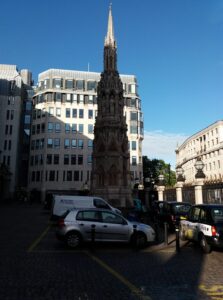
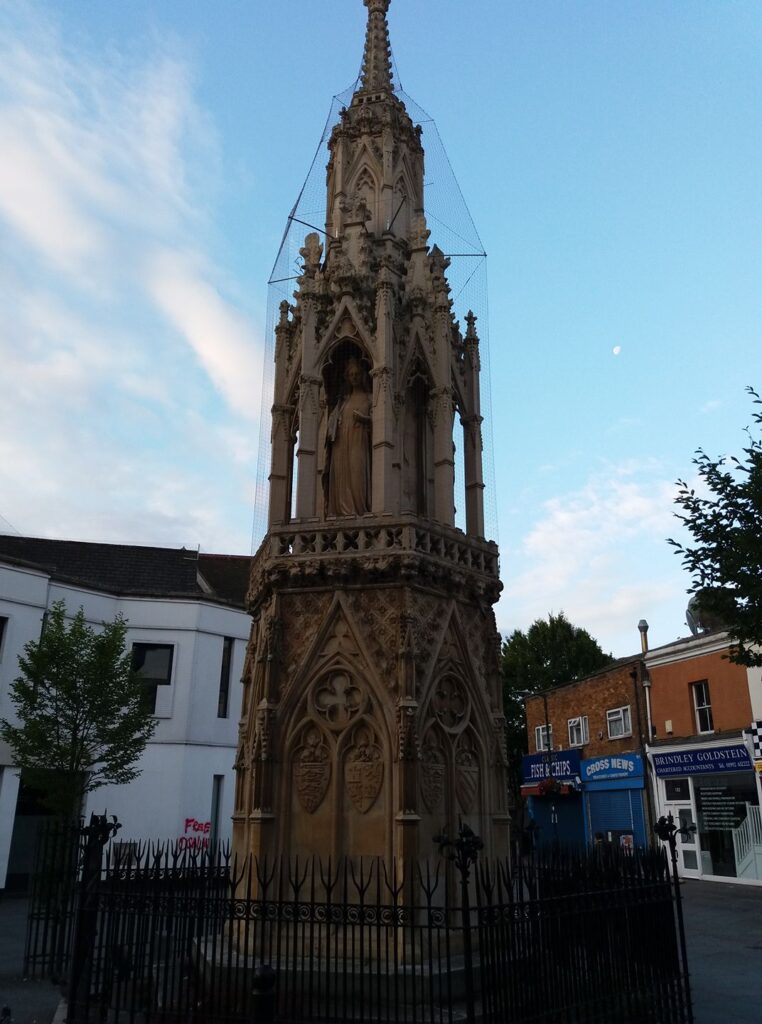
Replica cross outside Charing Cross Station

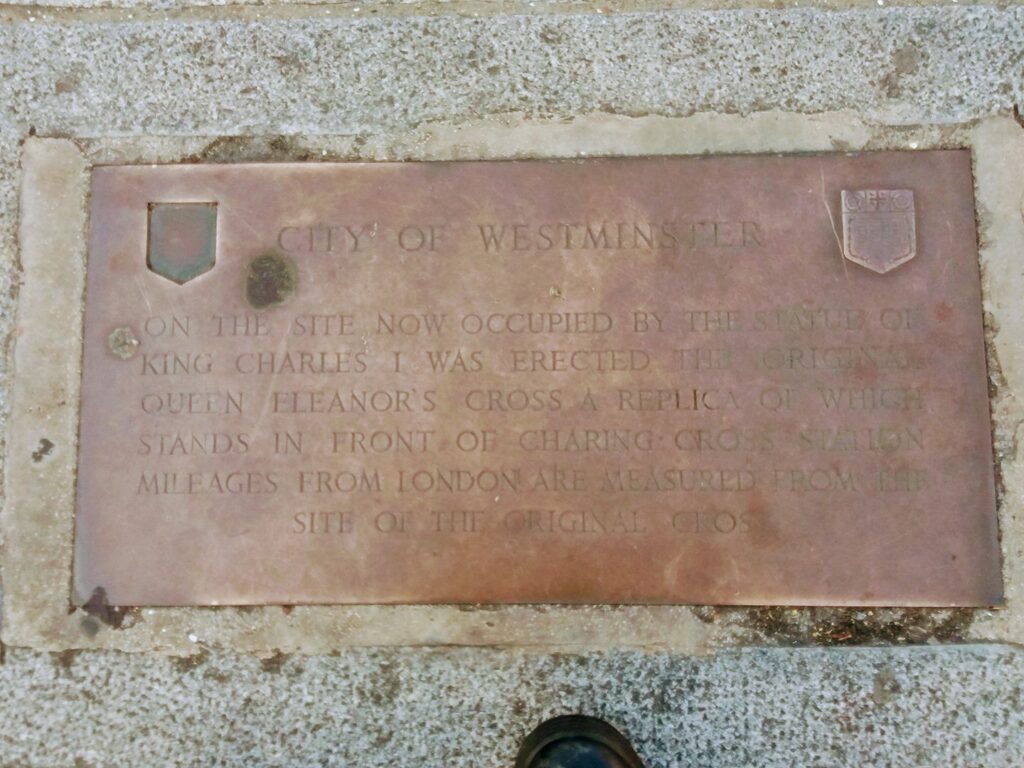
When you see road signs telling you the distance to London the distance given is to a point at the South of Trafalgar Square where a statue to Charles I currently stands. A plaque on the floor tells you that this was the location of the original Charing Cross (a replica of which now stands outside Charing Cross Station.

To find out how the original hamlet of Charing came to get such a monument and the addition to it’s name, we have to go back to the end of the 13th Century.

Site of the original Cross in Trafalgar Square

England at that time was ruled by Edward I (Edward Longshanks, the Hammer of the Scots) who at the age of 14 had been married to Eleanor of Castile as a way of averting an invasion of the English province of Gascony.

Despite being an arranged marriage, the relationship was close and Eleanor travelled extensively with her husband even joining him at Acre during the 8th Crusade.

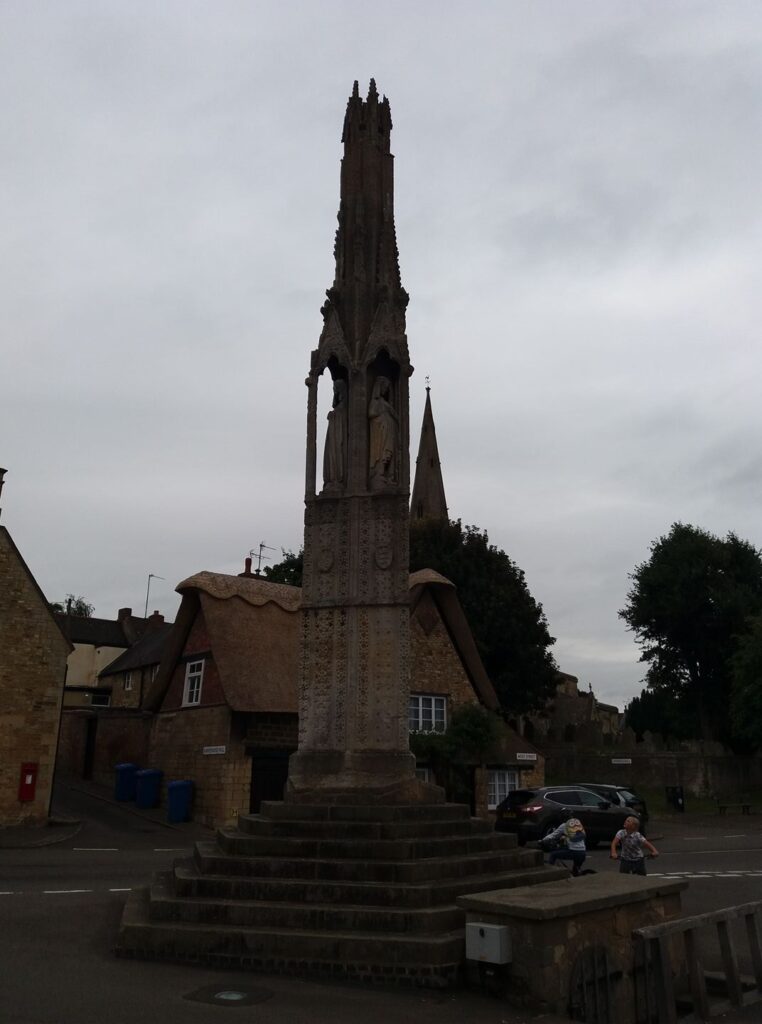
Eleanor Cross in Geddington

In 1290, the King and his wife made a tour of Eleanor’s lands in the North of England. During the tour, Eleanor’s health started to decline and slow their journey. Edward was forced to summon his lords to Clipstone in Nottinghamshire for his Autumn parliament. Once matters of state were completed, the journey resumed but her health meant they were travelling less than 8 miles a day.

Just 7 miles from their destination of Lincoln, the journey was abandoned at the villiage of Harby. The ailing Queen was lodged in the house of Richard de Weston where she died on the evening of 28th November, her husband at her side.

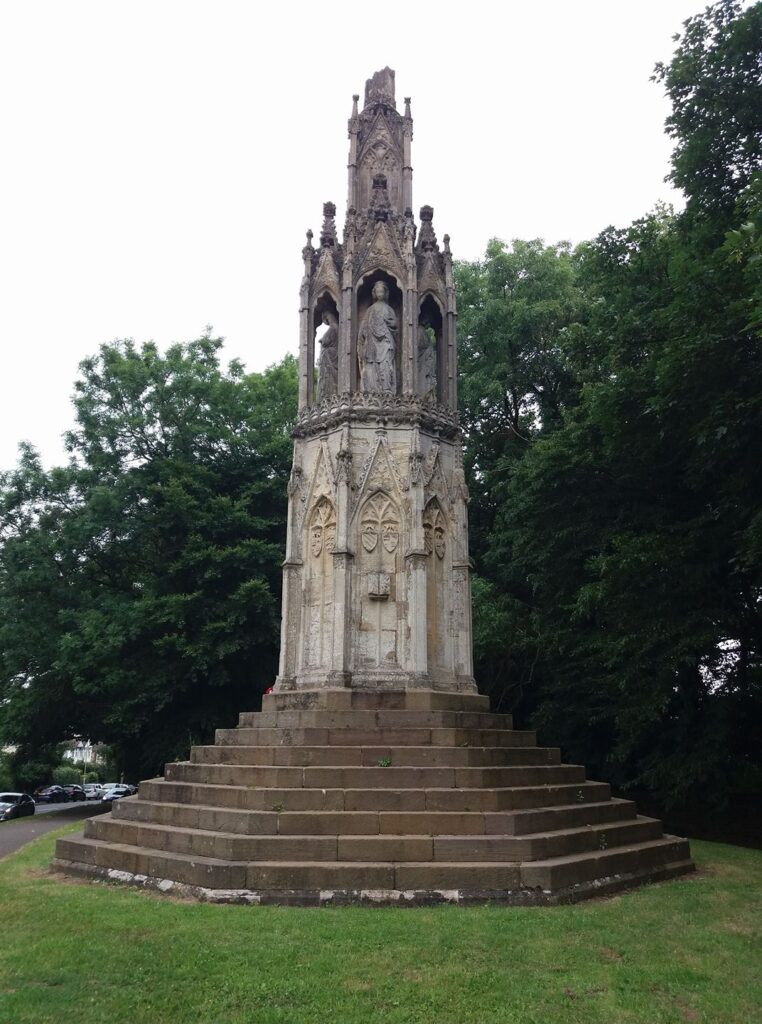
Eleanor Cross in Hardingstone

After being embalmed at Lincoln (her viscera removed at the embalming are buried in Lincoln Cathedral), her body was taken in state back to Westminster Abbey for her funeral which took place on the 17th December. Her heart was buried separately at the Dominican priory at Blackfriars along side that of her son Alphonso who had died 6 years earlier.

Eleanor Cross at Waltham Cross

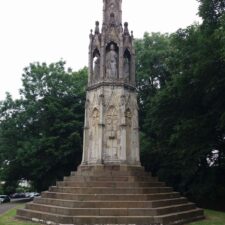
The King ordered memorial crosses of immense hight to be erected at the places where the funeral procession from Lincoln had stopped each night. (Lincoln, Grantham, Stamford, Geddington*, Hardingstone* near Northampton, Stony Stratford, Woburn, Dunstable, St. Albans, Waltham Cross*, Westcheap and Charing Cross) He also ordered that two wax candles were to burn for all time beside her tomb in Westminster Abbey.

The candles burned for two and a half centuries until the Reformation brought the practice to an end.

Three of the crosses have survived at Geddington, Hardingstone and Waltham Cross, although they have been restored over the years. Some were lost to neglect, others destroyed in a purge of Monuments of Idolatry and Superstition during the Civil War.

At Charing Cross, it’s original site usurped by the statue of Charles I, an embellished replica was erected in 1865 outside the newly built Charing Cross railway station.

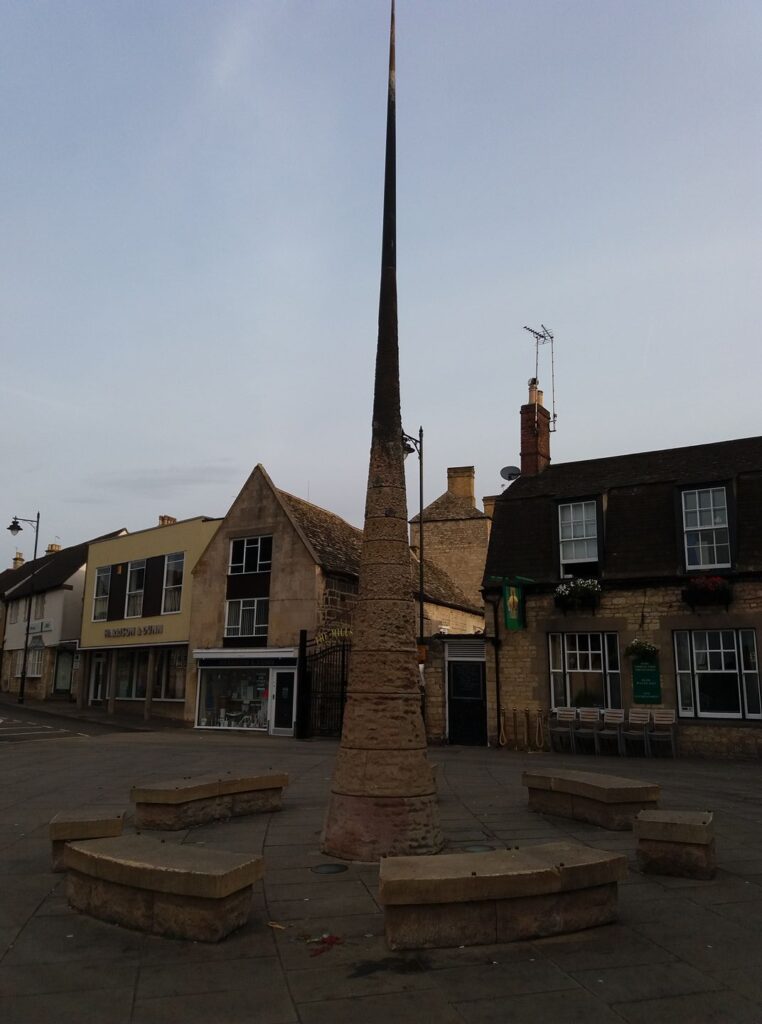
In 2007 a modern memorial was built in Stamford to commemorate the original cross, the tall slender spire is carved with roses a reference to the small piece of the original cross that still remains.

The modern memorial at Stamford

Rochdale Town Hall Fire

Rochdale Town Hall, is a fine example of gothic revival architecture and home to some of the best modern stained glass in the world. The grandeur of this building was such that according to local legend, Hitler had plans to take the building stone by stone back to Germany if he won the war. This is also supposedly the reason why Rochdale, despite it’s industry, escaped pretty much unscathed during the German bombings.

A competition was held to produce a design for the building which was won by William Henry Crossland. Work started in 1866 on the site of an abandoned 17th Century mansion and was completed five years later at a cost of £160,000 (eight times the original budget, and a remarkable sum for a town the size of Rochdale.) the work was so costly that to this day some of the internal decoration remains unfinished.

But what visitors to the town may not know is that the building you see today is different from the original.

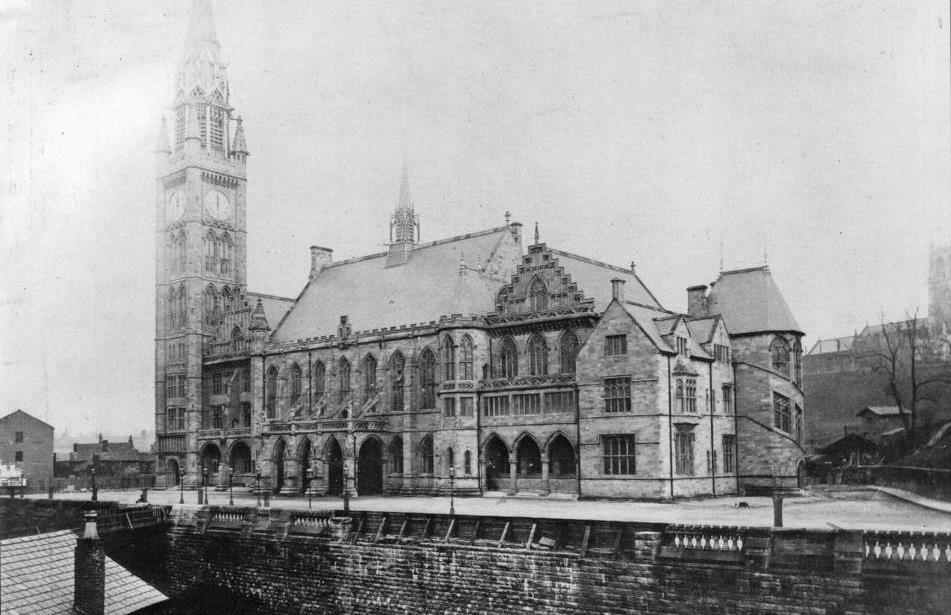
The original clock tower was 134 feet high and had a 106 foot wooden spire richly gilded and surmounted by figures of Saint George and the Dragon.

Rochdale Town Hall prior to the fire of 1883

But in 1882, dry rot was discovered in the spire and after much deliberation contractors were engaged to dismantle and rebuild it.

Whether by accident or by an attempt to speed up the process at 9:20pm on 10th April 1883 a fire was discovered in the Clock Tower. Chief Constable, Wilkinson sent a telegram to the fire-brigades in Oldham, Heywood and Milnrow to provide assistance.

Although the Rochdale fire-brigade was based in the town hall (now the registry office) Oldham and Milnrow were first to start tackling the blaze.

Oldham fire-brigade having arrived in 25 minutes were ready for action, but the Rochdale engine was forced to gallop round the town hall in order to draw enough air to get steam up to power their pumps.

Meanwhile thousands of people gathered around the edges of the town hall square to observe the horrifying spectacle.

The gilding of the spire reflected the blood-red glow of the flames and the clock faces shone far brighter than the gas lamps that usually illuminated them. Occasionally could be heard a shout, or a scream of terror from some female, as fragments of burning material came to earth with a great thud.

As the fire wrapped the tower in a deadly embrace streams of molten lead ran down from the spire and by half past ten the wood of the spire was consumed and the iron framework, having been heated to almost white-hot, gave way crashing to the ground at the rear of the town hall.

With the town-clerk’s offices in imminent danger of destruction, the clerk, with Thomas Foy and another man. ran inside to rescue as many documents as they could. At the same time Alderman Taylor called upon one or two men to follow him, which they did unhesitatingly, and went up to the Free Library  and began removing the paintings and books.

As the spire crashed down a great rod from the spire made a large hole in the roof of the clerk’s office and large lumps of bell metal fell into the room. A similar scene unfolded in the library with large lumps of metal and debris raining down.

Luckily none of the men were killed, but Police-constables Shaw and Schofield  were badly burned by moulten lead, however despite this they were able to continue their duties.

It took until one o’clock for the fire to be brought under control.

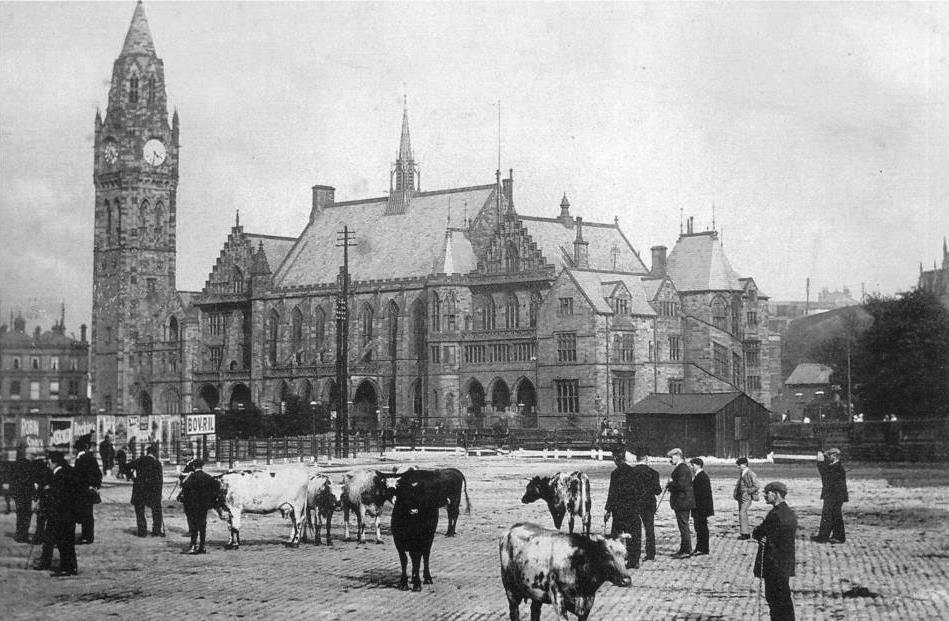
Rochdale Town Hall around 1908 showing the replacement clock-tower

The following morning when the Heywood fire-brigade arrived, (Having only just received the message as the local telegraph office closed at 8pm), only one or two slightly smoldering beams remained.

The replacement clock tower and stone spire was designed by Alfred Waterhouse two years later and opened in 1888. It stands 15 yards from the site of the original tower.

The rooms at the base of the original clock tower were preserved and still form part of the main body of the town hall.

Stott Hall Farm – A Modern Myth

Stott Hall Farm

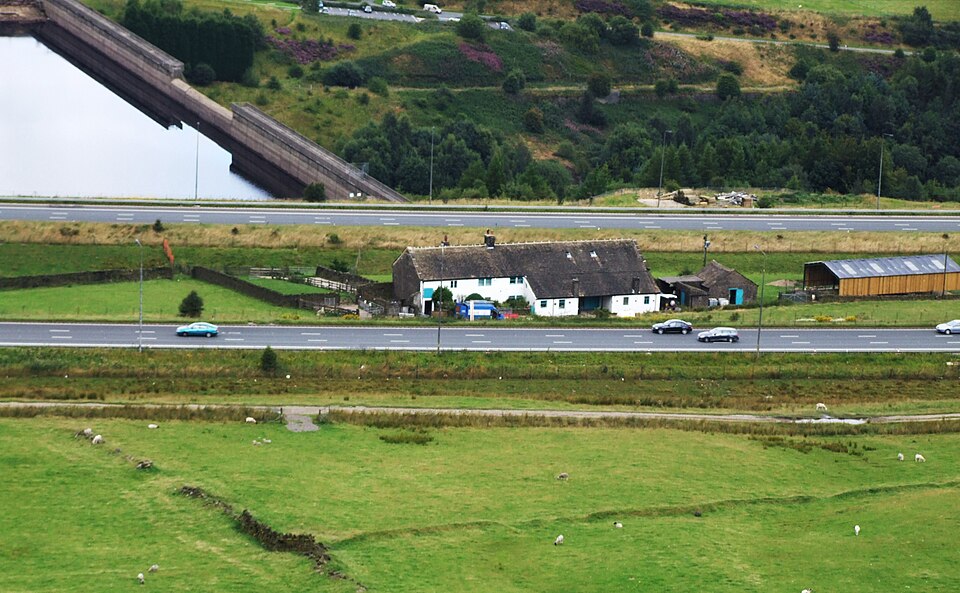
In the 1970′s, the M62 (built to connect Hull and Liverpool) forged it’s way across the rugged Pennine hills making it the highest motorway in England. Just over the border into Yorkshire lies Stott Hall Farm, instantly recognisable to anyone who has traveled this route and quite a few who haven’t.

The farmhouse (built in 1737) now stands isolated by the two carriageways of this busy motorway, which pass to either side. Modern mythology would have us believe that this was all down to the stubbornness of Ken Wild, the man who lived in the farm at the time.

Whilst hundreds of homes were demolished to make way for this major artery across the country, Stott Hall Farm remained standing. Despite offers of ludicrously large sums of money by bowler-hatted civil servants who reluctantly came up from Whitehall to this desolate location, the farmer refused to budge and the Government was forced instead to change the plans at great expense.

The truth is, that it was the land itself that forced the mile long rent, the waterlogged moorland and steep incline on the hill making it impossible (at the time at least) to construct the two carriageways side by side without the land slipping and destroying the construction.